Welcome to Ahavas Sholom – an Historic Landmark and Sacred Space
“Reflections on my Sacred Pilgrimage to Selma”
by Rabbi Eliyahu (Elijah) Collins
April 19, 2025
Approximately two years ago, I was encouraged by the long-time president of Ahavas Sholom, Eric Freedman, to participate in a Black/Jewish dinner that is hosted every month at the New Jersey Performing Arts Center (NJPAC). Our cohort is composed of clergy members, civic leaders, college faculty, and individuals who head a plethora of social justice programs and initiatives. During our meetings, we break bread together and engage in in-depth discussions, regarding the shared legacy of oppression and resilience among Black and Jewish communities. In recent months the group’s attention turned to exploring the nascent phase of Black and Jewish kinship, political and social factors that aided its formation, and how the bond between these two forlorn groups began to fray over the process of time.
Through discourse we concluded that to bolster the bond among our group we must unabashedly consult the past. We believe that recalling the strong allyship between Black and Jewish communities, during some of the most turbulent, uncertain, and hostile times in human history, will strengthen our resolve to stand united amid the divisive ploys of today. It is with this objective that nine of us set out for Selma, Alabama, in recognition of the 60 Anniversary of “Bloody Sunday.” This is not an isolated occurrence of unity between Black and Jewish communities, nevertheless, the horrific event of that day continues to prominently illustrate their shared investment in the continuing fight for freedom, justice, and equality.
Our first tourist site, after we arrived in Selma, was the famed “Legacy Museum: From Enslavement to Mass Incarceration.” It was a quick walk for Eric and me to the Museum. As I approached the site, I was struck by the building’s name, which was prominently displayed in bold black letters that seemed to be raised atop its façade. Minutes after entering the building, I had a chance encounter with a rabbinic colleague and classmate, who I did not know was in Alabama. We exchanged pleasantries and I briefly spoke to the rabbi, who was his traveling companion, and some of the members from their synagogue. After taking a few pictures to memorialize the event, I headed to the scanner at the security booth. There I was greeted by a fellow attendee, who advised all in earshot, to walk out of the building to regain composure, if they began to feel overwhelmed by the displays. Suddenly, I experienced a shift in my mood, and the gravity of what I was about to experience, during my vicarious trek through history, took center stage in my mind.
Once I passed through security, I entered a room that was dimly lit and emitted an ominous feeling. There were several huge screens that showed an ocean. I was engulfed in the loud, thunderous sound of crashing waves. Intermittently there were sharp bolts of lightning that pierced through the darkness in the room. Written amid the waves was the horrific declaration, “12 million Africans were abducted and forced into slavery from the 16th -19th century.”
This would be the start of the treacherous path from slavery to mass incarceration. The museum captured and reflected the progressive phases of dehumanization suffered by those who were stolen from their native continent. Graphic pictures, woodwork, personal narratives, and statistical reports served as empirical evidence of the unfathomable. They told the story of the unconscionable brutality inflicted on the enslaved to extinguish any drive to resist subjugation; they spoke of the victims being ruthlessly cast to the four winds as they were sold, bartered, and exchanged for agricultural products and raw material; and they related scores of brutal and dishonorable practices of suffering that would only be unearthed and told by those who have great fidelity to truth. As the Museum led us through the history of the bloody plantations, post plantation era, and Civil Right Movement, we also saw that the response to every advancement toward respecting the rights, dignity, or humanity of the enslaved or formerly enslaved was a circumventing of the law or abject violence.
Although I was deeply moved by everything that I witnessed, there were two exhibits that left an indelible impression on me. The first was a room that housed several metal animal pens. They were dingy and narrow. A hologram of an enslaved person emerged from the back of each pen when I stood in front of it. Their visages were severely marred, and their clothes were tattered. There was a look of pain on their face. As they approached, they shared their story of how they were captured. Many gave tearful accounts of being stripped of their family and having to endure the agony of not knowing if their loved ones were alive or dead. The other exhibit was a wall that contained hundreds of personal letters written by the enslaved. They were heart-wrenching accounts of married couples who were forced to face the painful reality that this would be their last night together as one or both would be sold at the rising of the sun. Mothers’ fervent pleas to have their children remain on the plantation with them in servitude, in lieu of being separated, were disregarded. Oftentimes they were violently kicked and whipped as they refused to relinquish their hold on the wagon that threatened to separate them from their children forever. Accounts of systemic deterioration of the family unit and its protracted psychological and emotional impact filled the four walls of the large room.
Upon our departure from the museum, we took our journey to the “National Memorial for Peace and Justice.” Inside and outside of the memorial site were large brick pillars that stood in close proximity to each other and only permitted a narrow passage between them. Inscribed on each pillar was the name of a person who was lynched and the state where the murder took place. When taking a closer look, I perceived that many of the pillars did not contain a single name but recorded mass hangings. The individual names of the slaughtered remain obscured from the annals of history and their life and death are relegated to statistics.
The site had a winding contour to it with pillars affixed to the ground, suspended in air and laid out in rows on the ground to resemble a grave site. I felt compelled to honor the life and death of the slain and nameless by reading as many of the pillars that I could. Eventually what I had feared and yet strongly suspected occurred when I lighted upon a pillar of someone who held the same surname as myself. Her name is Jennie Collins. Her pillar simply read her name, Jennie Collins, and the date of her hanging, June 30, 1914. I wondered, “Who was Jennie Collins? How old was she at the time of her death? What might she have become if given the chance to exercise autonomy? How many degrees of separation exist between the two of us?” These are all inquiries of which I am denied answers. However, gazing at Jennie’s pillar I knew that she will never be forgotten, or become some random name inscribed on a wall. Jenny and all the mystery that surrounds her have become an intimate part of me.
On Friday, February 7, 2025 we began our quest to understand the contributions of Jews to the Civil Rights movement and the impact that this epoch in history had on southern Jewish communities. We attended “Kabbalat Shabbat” services at Temple Beth Or, located in Montgomery Alabama. For many members of our group this was a new experience. The service was conducted by Rabbi Scott Looper with two cantors and musical accompaniment. The melodic recitation of the Psalms and traditional prayers filled the synagogue and displayed the beauty of Jewish heritage and tradition.
Rabbi Looper delivered a poignant message suited for the historical occasion. He spoke of his earliest awakening to the racial divide in his community. He vividly described his struggles during youth to reconcile the disparity between the polarized world that he was experiencing, and the just and equitable world that Jews are duty bound to create, foster, and protect. Rabbi Looper drew upon the scriptures and rabbinic commentary to show that practices of discrimination and racism are antithetical to Torah and the greatest threat to humanity. His message conveyed a narrative of courageous southern Jews whose moral and ethical convictions compelled them to participate in the march across the Edmund Pettus Bridge for voter’s rights, and other organized protests and demonstrations against injustice. Many southern Jews took their righteous stance at the peril of social isolation, bodily harm, or destruction of personal and/or synagogue property. Rabbi Looper’s message was a Call to Action in response to the continued systemic acts of violence inflicted on Black citizens in Montgomery, and growing antisemitism in the south.
During Shabbat Dinner, the group was afforded an intimate conversation with Rabbi Looper and Phillip Ensler. Mr. Ensler established a career in Montgomery Alabama as a Civil Rights Attorney and in 2022 was elected to the Alabama House of Representatives. He is also the Executive Director of the Jewish Federation of Central Alabama. Mr. Ensler’s unique perspective due to his legal expertise and administrative work gave us the political backdrop to some of the issues that face Black and Jewish communities. I left the Dinner with a strong appreciation for the difficulty of Mr. Ensler’s task of balancing his fidelity to Torah and his Jewish heritage with his work in the Alabama House of Representatives, with people representing conflicting political parties and agendas.
On the early morning of February 9, 2025, we enthusiastically awaited our opportunity to participate in the historic reenactment of the march across the Edmund Pettus Bridge. People seemed to converge on the bridge from every narrow street and corner. The highway leading up to the bridge overflowed with a beautiful collage of people, representing various age groups, ethnic backgrounds, and religious affiliations. Merchants sold T-shirts, hats, coffee mugs and other accessories to commemorate the day. Children showcased their singing, dancing, and artistic ability. Choirs sung songs termed “Old Negro Spirituals.” Members of the Masonic Lodge added a form of pageantry to the march, decked in their distinctive royal apparel, as they walked across the bridge, with pride and dignity. People introduced themselves to each other, taking pictures and engaging each other with warmth and mutual respect.
At some point during the march, I heard a low voice among the bustling crowd, but I could not make out what was being said. As I tried to listen intently, I saw that this singular voice permeated the crowd like an infection. It grew in volume and strength as it joined with other voices like a rippling effect of waves. Suddenly I heard it clearly. They were singing, “We Shall Overcome” I immediately saw people rushing to lock arms with strangers in a sign of unity, as they sang harmoniously, “Deep in my heart, I do believe that…” They gave no heed to any perceived ethnic or socio-political differences. It was clearly an unscripted and unrehearsed moment of human beings embracing a shared struggle and history. I was completely taken by this moment of solidarity.
The majority of Jews who attended the 60 Anniversary of “Bloody Sunday.” were White. On the bridge I met many of them. They were easily distinguished among the crowd by their apparel which bore Jewish symbols. Some wore hats bearing the phrase, “Am Yisrael Chai’ (The people of Israel live). Others wore T-shirts with the names of Jewish organizations that they represented. Many carried banners with the names of their synagogues. The clothes I wore also strongly expressed my Jewish heritage which made me easily noticed by other Jews.
During our encounter we exchanged information about our respective synagogues and personal motivations to participate in the march. Many referenced the relationship between Dr. King and Rabbi Heschel. They saw this as an example that is to be treasured and emulated.
Through conversation I discovered that all of the Jews I encountered were not natives of Alabama. In fact, many of them reportedly traveled from the North and distant states for the sole purpose of participating in the historical reenactment. They expressed their intention to immediately travel back home after the activities. Reportedly they had no other agenda for being in Selma. Their willingness to travel for hours, by plane or car, so they could take a thirty-minute walk over a bridge, for justice, is an undeniable testament to their commitment to the principles of Torah. I left these encounters feeling optimistic.
In recent days I have come to realize my struggle to convey with words what I experienced during my trip to Selma and particularly on the Edmund Pettus Bridge. I imagine many may think that it’s just a fleeting emotion that will eventually give way to the harsh realities of today. Or they may conclude that it’s delusional to believe the brotherhood and unity that I witnessed is more than an idyllic moment; however, for me this is an emerging reality.
As I continue to process the trip, I see Ahavas Sholom as a microcosm of all that was good on that bridge. The synagogue embodies the spirit of the righteous obstinacy and civic responsibility that was evident on “Bloody Sunday” and all subsequent reenactments of this fateful day. The bold, progressive, and committed leadership of the synagogue’s President, Eric Freedman and the executive board, ensures that ‘Tikkun Olam’ (Repair of the world) is not just an attractive ideal, but a vibrant and pulsating force that guides the shul. It has led to the synagogue’s history of social justice initiatives as well as our current portfolio of community enhancement programs, both here and abroad. It was this unyielding drive of the synagogue to work toward repairing the world, that strongly encouraged an Israelite Rabbi and Ashkenazi Jew to take a shared journey, as brothers, through history, and to emerge from the portal of time, with a clear and collective vision for the synagogue’s future.
During many intimate conversations I had with President Freedman, I would often tell him that I strongly believe that Ahavas Sholom’s work will change the world. Today, I no longer believe that the synagogue will change the world, for I am confident that it has already done so.
Mission Statement
As the oldest continuously operating synagogue in the City of Newark, Congregation Ahavas Sholom is an Egalitarian Conservative Synagogue with a traditional service that welcomes all Jews, fulfills their spiritual needs, provides educational and cultural experiences.
The synagogue’s mission states that Ahavas Sholom is passionately committed to the pursuit of Tikun Olam (repair of the world) and Tzedakah (social justice). Ahavas Sholom recognizes as part of Tikun Olam that it has an obligation to the environment, physical space and activities of the community. We therefore consider support for the conservation of open space, the creation of both passive and active recreation in Newark and among communities within its metropolitan area to be part of our mission.
Ahavas Sholom is characteristic of other religious institutions in Newark. Just as many inner-city churches draw the greater part of their members from outside the city itself, Ahavas Sholom now has relatively few congregants who live in Newark.
American cities are redeveloping in part as their unsurpassed cultural and religious institutions attract suburbanites to meaningful experiences. Ahavas Sholom is holy ground. It inspires those who step through its doors to pray, think, and learn, and to care about each other’s lives and the life of the community.
We Celebrated Eight Adult B’nei Mitzvah
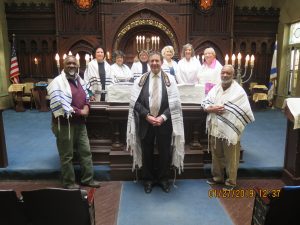
Bottom Row: Tim Bezalel Lee of Newark, Rabbi Simon Rosenbach, and Daviyd Hawkins of Newark. Top Row: Wanda Rubinstein Gohler of Newark, Flora Sonners of Parsippany, Alla Eicheldinger of Newark, Marianne Moy of Roselle Park, Joan Podnos of West Orange and Linda Bloom of Bloomfield.
On Saturday, March 16, 2019, the Ahavas Sholom community celebrated eight of our members who were called up to the Torah as adult B’nei Mitzvah.
For many weeks the group studied and prepared for this day, under the leadership of Rabbi Simon Rosenbach.
They are men and women, mostly in their 60’s, from many differet Jewish backgrounds, who have been waiting a lifetime for this opportunity.
Some were born outside the United States, some were born into another religion, and some were just never given this opportunity as a 12 or 13 year old.
To read the New Jersey Jewish News article about our eight adult B’nei Mitzvah click here.
If you have any questions please call Jeff at 973-207-3095.
#newark #newarkevents #ahavassholom #Jewsofnewark